Prince’s death in the mail-cart collision
Tess of the d'UrbervillesPrince’s death in the mail-cart collision is a turning point in the Durbeyfield family’s fragile economy and in Tess’s sense of responsibility toward them. A night journey undertaken to save the family’s beehive trade ends with the horse dead and the loaded wagon stranded; Tess treats the accident as her own fault, while its practical consequence is to push the household closer to distress and prompt her mother to seek help from Mrs d'Urberville.
Causes and Background
The journey is urgent because the beehives must reach retailers in Casterbridge before the Saturday market. The family stays up until eleven, and the latest practical departure is two in the morning: the route is twenty to thirty miles over bad roads, and both the horse and wagon are slow. When Tess’s father cannot make the trip, the family faces losing the market for the hives and being left with them until their seasonal demand has passed.
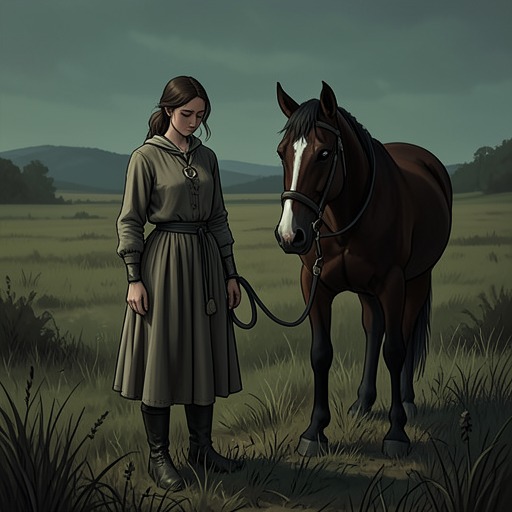
Tess refuses her mother’s suggestion that one of the young men who had danced with her should go. She does not want the reason for such help to become public, and says she will go if her younger brother Abraham accompanies her. Their mother agrees. Tess dresses quickly, wakes Abraham, and leads Prince from the stable to the already loaded, rickety wagon. To spare the weak horse, the children initially walk beside him on uphill stretches. The lantern hung on the load provides their small artificial morning as they set out in the dark.
The Collision and Prince’s Death
After the journey has carried them some distance, Tess falls asleep and wakes when the wagon jolts to a stop. Its lantern has gone out, and the harness is tangled with an obstruction. The mail-cart, travelling along the lane, has collided with the slow, unlighted wagon; its shaft has fatally struck Prince. Tess rushes forward, but cannot save him. The mail-cart driver explains that he must continue with the mail-bags and leaves her to wait with the load, promising to send assistance.
Tess and Abraham remain at the roadside until a farmer’s man arrives from near Stourcastle with a strong cob. He substitutes the cob for Prince so the beehive wagon can continue toward Casterbridge. That evening, the empty wagon returns to the scene. Prince’s body, which has remained beside the lane, is placed in the vehicle he once pulled and taken the eight or nine miles back to Marlott. The journey thus divides into two starkly different outcomes: the hives reach their destination, but the horse on which the family depended does not return alive.
Tess’s Response and the Family’s Loss
Tess had returned to Marlott before the wagon came back. She cannot think how to tell her parents, and feels relief when she sees that they already know of the loss; knowing this does not ease her self-reproach. When the family learns that the knacker and tanner will offer only a few shillings for Prince’s carcass because of his age and weakness, the poor return compounds the practical loss of the animal itself.
Tess’s response is markedly harsher than her parents’ response to her. She regards the accident as her doing and worries aloud about what her mother and father will live on now. Abraham had slept through the collision, and Tess wakes him to tell him they cannot continue with the load because Prince is dead. At home, the children cry as the horse is buried; Tess alone remains dry-eyed and pale, seeming to regard herself as a murderer. Her self-accusation gives the death an inward consequence beyond grief: she takes responsibility for an accident that the narrative presents as a collision on the road.
Economic Consequences and Narrative Significance
The beehive trade had depended mainly on Prince, so its sudden loss disorganizes the family’s haggling business and makes distress, potentially penury, loom nearer. The household’s insecurity is worsened by the father’s unreliable capacity for regular day labour: he can work strongly at times, but those periods cannot be counted on to coincide with need. The horse’s death therefore removes not merely a possession but a means of carrying the family’s goods to market, at the very moment they have little dependable labor or money to fall back on.
Tess silently wonders how she can help the family out of the predicament, and her mother turns the loss into the reason for another course of action. She tells Tess that the family must take both good and bad fortune and urges her to approach the wealthy Mrs d'Urberville, whom she believes to be their relation, to ask for help. Prince’s death consequently links the failed market journey to Tess’s ensuing effort to support her family: an attempt to repair the damage at home becomes the pressure behind seeking assistance from a supposed aristocratic connection.